
Madison County's Selected Wanted List
For wanted notices with photos, go straight to the Madison County Sheriff's Department Most Wanted panel. The list recently carried just one listing. That count can move at any moment. No update schedule is published, so the panel may lag behind reality. A missing name does not clear a warrant. Someone still pictured may already have resolved the matter by the time the page catches up.
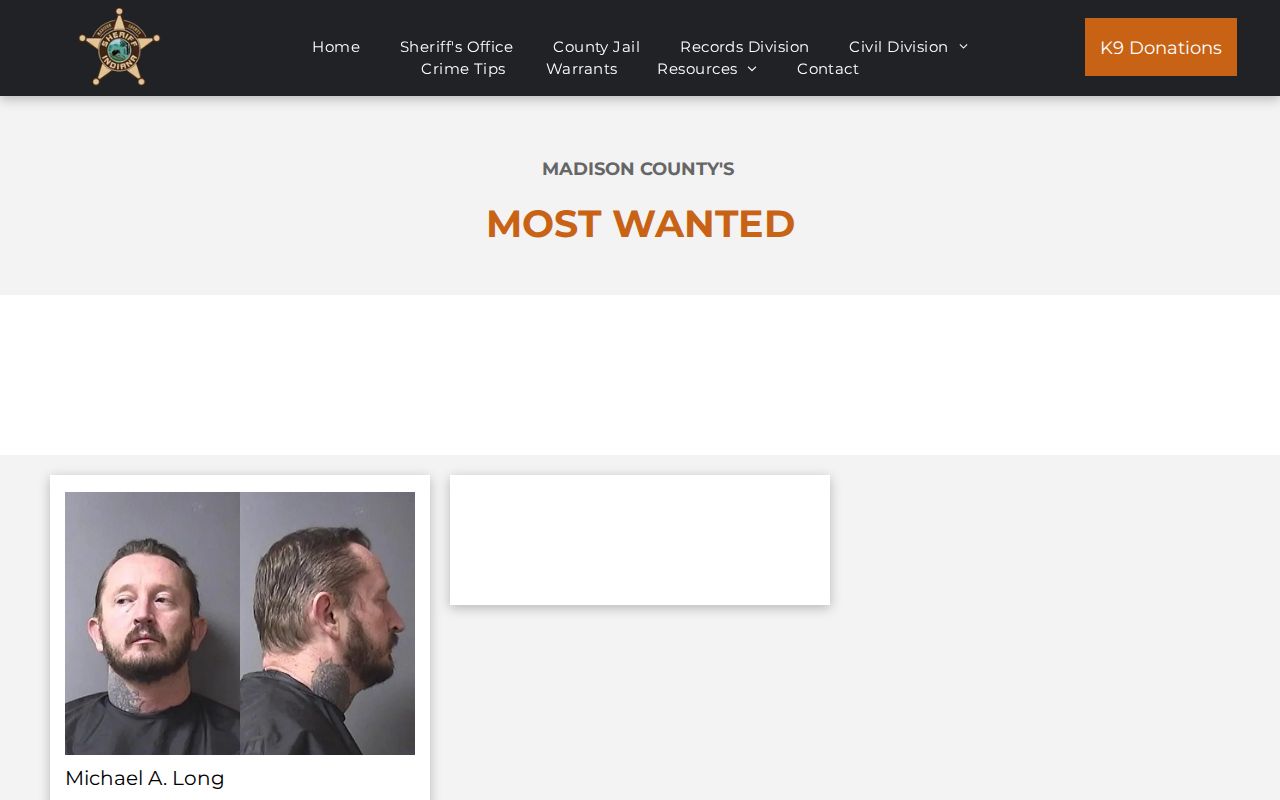
The sheriff posts a selected panel of wanted persons online. Think of it as a public-safety notice, not a full warrant database for Madison County. Each entry gives a photo, basic identifying details, and the reason police want the person. Go to the official page each time. Skip saving copies of the images. Reading the sheriff's current wording is safer, and it keeps you from spreading an old photo after a status changes.
Fields in a Madison County Wanted Notice
The sheriff's panel is compact. Every field helps separate one notice from a same-name person. Read them together, though. No single field, on its own, confirms that you have matched the right individual.
| Field | What the sheriff panel showed |
|---|---|
| Photograph | An agency-posted image used for identification. It is not proof of the alleged conduct. |
| Name | The name attached to the selected notice. |
| Alleged offense | The stated basis for the wanted feature, subject to later court action. |
| Date of birth | An identifier that can help separate people with similar names. |
| Sex and race | Descriptive fields published with the observed listing. |
The published notice text did not include a last-known location, a caution flag, a reward, or a promise of anonymity. Nor did it state how often the panel gets refreshed. Don't assume any of those details exist. Stick to what the current official notice actually says.
How to Read Madison County Wanted Fugitives
Keep three things separate: who the person is, your own safety, and record verification. A screenshot goes stale fast. Returning to the official panel every time prevents that problem.
- Open the sheriff's official Most Wanted panel rather than a copied post or search-result preview.
- Note the date and time of the check, because the department gives no fixed posting schedule.
- Compare more than a photograph. Read the name, date of birth, sex, race, and alleged-offense text shown by the sheriff.
- Do not approach, follow, detain, warn, or confront the person. Move to a safe place.
- Send a tip through the sheriff's official route. Give the source and time of the observation without publishing it online.
- After an arrest, use the Madison County inmate inquiry process to distinguish a booking from a still-open wanted notice.
A county booking may appear later in the jail inquiry. Those entries usually list a booking date, the arresting agency, the charge, bond, and court fields. The new record just marks a later stage. It changes nothing about what the original wanted notice said.
Checking a Madison County Warrant
The sheriff's warrant page lets you search by name or other warrant details. Expect some lag. The site itself warns results can run up to 23 hours behind. The "View Warrants" button leads to a password-protected sheriff blotter, so the public cannot use it as an open search tool.
An empty page or failed login does not prove a warrant is absent. The stated delay matters, and so does the restricted destination. Build your verification around both facts instead of one attempt.
- Read the official warrant page and its 23-hour warning.
- If the results remain restricted, do not substitute a commercial people-search result.
- Contact the Madison County Sheriff's Department at 765-642-0221 or the court connected with the matter.
- If a case number is known, search Indiana MyCase and match the court, filing date, and party identifiers. A name alone is not enough.
- A person who believes a warrant concerns them should speak with an attorney or the proper court and arrange a safe, lawful response.
The Sheriff's Records Division handles the formal public-record route. Call 765-646-9290 or write to sheriff_recordsdivision@madisoncounty.in.gov. Staff will search for an actual record, so give them a full name, an approximate date, a case or warrant number, or other useful details. A vague question with nothing to locate will not produce an answer invented on the spot.
Madison County Warrant Terms
Warrant labels describe where a court's authority comes from and its procedural posture. That is all. A label does not mean anyone was convicted, and a web list may leave out qualifying details the court can see.
| Term | Practical meaning for a check |
|---|---|
| Arrest warrant | Judicial process authorizing an arrest based on the underlying matter. Verify the issuing court and current status. |
| Bench warrant | Court-issued process often connected with a missed appearance or failure to follow a court order. Confirm with the court. |
| Failure-to-appear process | A court record may show the hearing and later action. The docket is more useful than a copied listing. |
| Selected wanted notice | A sheriff-chosen public feature. It is not a separate warrant type and is not a complete list. |
The category name alone is not the answer. The issuing court and the sheriff hold the controlling details. A warrant's status can change in several ways. Service, recall, quashing, a court appearance, or another official action will do it. Only the responsible office can confirm that a change happened.
Send Madison County Warrant Tips Safely
Tips go to warranttips@madisoncounty.in.gov for warrant information. The separate crime-tips page is the other channel. No published promise of anonymity exists. There is no reward offer either. Don't attach either expectation to what you send.
Warrant tips: warranttips@madisoncounty.in.gov
Dispatch and non-emergency: 765-642-0221
720 Central Avenue, Anderson, IN 46016
A useful tip states what was personally observed, when and where it was observed, and how the sender recognized the official notice. Avoid conclusions, threats, public accusations, or attempts to test whether the person will respond. Call 911 for an immediate emergency.
From Madison County Warrant to Court Record
A wanted panel shows why public attention started. Indiana MyCase shows what happened in the judicial file afterward. Search the public court portal with a case number when you have one. If you search by party name, add other identifiers first. Then confirm the case belongs to the right county and court. The chronological case summary tracks filings, hearings, warrant action, amendments, dismissals, pleas, judgments, and sentences.
A jail booking marks another stage. The Madison County inmate inquiry may show that a person was processed. It can also show whether the database currently marks them in custody, plus the booking origin or arresting agency. It does not replace the court docket. A blank scheduled-release field tells you nothing on its own. A SAVIN/VINE notice covers custody movement only, not the final result.
Why the Madison County Lists Differ
Madison County keeps three limits on its fugitive listings. The Most Wanted panel is hand-picked and short. The warrant page carries a 23-hour lag. Its results page was locked. So an empty result on either page cannot rule out active judicial process.
There is no public sheriff mobile app. No recurring social feature, such as a "Warrant Wednesday" post, has been confirmed either. Plain icons on a social page do not prove an account shares a full roster. For a solid answer, go straight to the sheriff or the issuing court, then check MyCase for public case events.
Q: Does no result mean no warrant? No. Delay, name variation, access limits, and incomplete selected lists all make direct confirmation a must.
Searching also means separating identity from status. To match a record to the right person, you may need a birth date, case number, court, and filing date. Whether a warrant still stands is a separate question for the sheriff or issuing court. Cached snippets and old posts can keep text alive after an official page changes, so note the office you called and when. And if safety is at risk, call emergency services instead of chasing an online comparison.
Public Record Search
Sponsored Results